
Provisional Tax Time: First Payment for 2027 Tax Year Due 31 Aug
“Provisional tax is merely an advance payment of a taxpayer’s normal tax liability.” (SARS)
For many taxpayers, it feels as if you’re making income tax payments all the time.
It’s not far from the truth because, in South Africa, provisional taxpayers make two compulsory payments (and possibly a third voluntary payment) each year. And that’s even before the annual income tax deadline in January of the following year, when any further tax liability will become due.
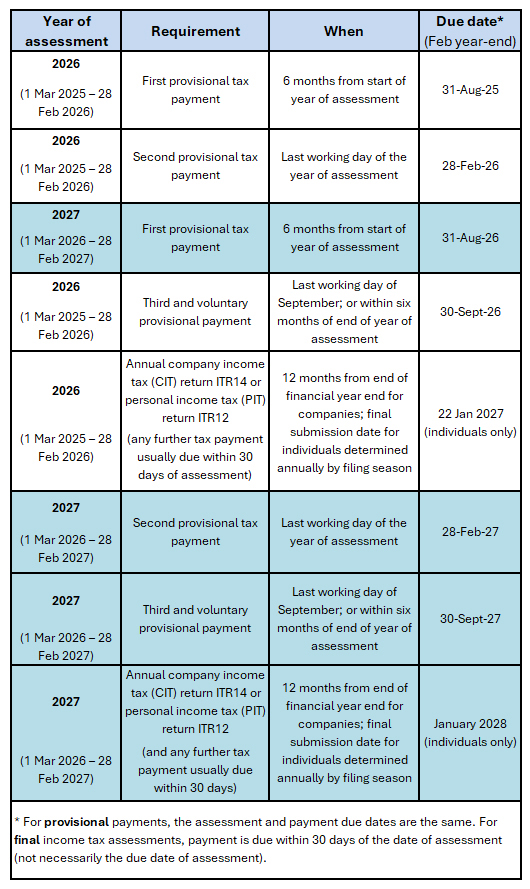
As a result, there are numerous deadlines that overlap across tax years. Yes: it is confusing, as the table below illustrates. But there’s no point throwing your arms up in the air: provisional tax non-compliance is met with some of the harshest penalties imposed by SARS.
Provisional and income tax timelines
Who are ‘provisional taxpayers’?
- All companies except those specifically excluded
- Any person who earns income which is not remuneration, an allowance or advance or who earns remuneration from an employer not registered for employees’ tax except those specifically excluded
- A labour broker with an exemption certificate
- Any person notified by the Commissioner of SARS
Why must provisional tax be paid?
Provisional tax payments are like instalments on taxpayers’ annual income tax, paid in advance and spread over two or three payments during the year. These payments are deducted against any tax owing after the year’s final income tax return is filed – at which point any further tax liability will then become due.
The objective is to prevent taxpayers from facing large income tax liabilities that are only revealed at the end of the year of assessment.
How is provisional tax declared and paid?
- Provisional tax payments are calculated on estimated taxable income, including current taxable capital gains, for that particular year of assessment.
- The estimates, says SARS, must be determined sensibly and by careful reasoning and judgment, in a mathematical manner, and using experience, common sense and all available information.
- The first period estimate is forward-looking, requiring companies to estimate their taxable income for the year ahead and then to pay tax on this estimate in advance.
- In contrast, the second period provisional return is retrospective, since by the year-end there is more certainty regarding the income for the year, and the tax due thereon.
- These estimates of taxable income are submitted to SARS on an IRP6 return, which must be submitted by all provisional taxpayers for the first and second periods.
- Even if you or your company owes no tax, a ‘nil’ return showing taxable income is equal to zero must still be filed on time.
- If an IRP6 is filed more than four months after the deadline, SARS considers a ‘nil’ return to have been submitted, and unless the actual taxable income is really zero, this will result in penalties.
- Accurate records of all the calculations and source documents used must be kept as SARS can ask for the estimate to be justified and, if dissatisfied with the amount, increase the estimate.
Do call on our professional assistance
All taxpayers are ultimately responsible for their tax affairs, even though provisional tax is particularly daunting and confusing, with so many overlapping deadlines, complex requirements and harsh penalties.
Expert tax advice is highly recommended to ensure compliance with the requirements and the filing and payment deadlines. You know who to call.
Disclaimer: The information provided herein should not be used or relied on as professional advice. No liability can be accepted for any errors or omissions nor for any loss or damage arising from reliance upon any information herein. Always contact us for specific and detailed advice.
© AccountingDotNews