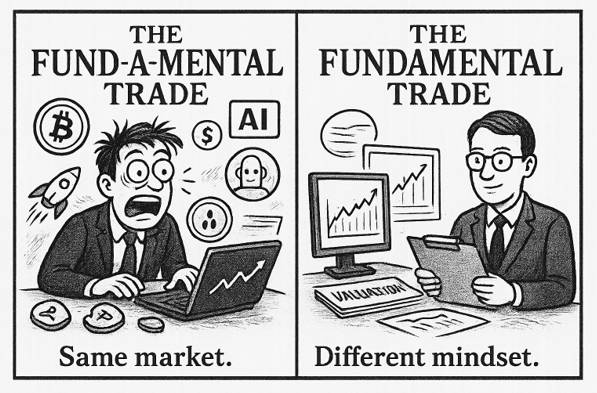
The Fund-a-Mental Trade vs. The Fundamental Trade
Growing up in the UK in the noughties (early 2000s), I became accustomed to long winters, very occasional sunlight, and an extremely pale version of myself. I do, however, feel extremely fortunate to have been blessed with an arsenal of uniquely British expressions that now evoke a fair amount of nostalgia when heard.
It has been many years since I have heard something described as “Absolutely Mental!” – meaning either awesome and exciting, or extremely stupid. Yet in the world of investments, few expressions currently seem as fitting.
Whether the vehicle is cryptocurrencies, Krugerrands or tech stocks, many investors have fallen for the FOMO trade, allowing hype and the fear of missing out (FOMO) to influence their investment decision-making.
I am by no means claiming that there is no validity to the thesis that increased central bank buying supports the gold rally, or that AI innovation is resulting in a step-change in the productivity of companies across sectors. I am merely cautioning that the moment sentiment becomes a prominent driver of market returns, care needs to be taken when gaining exposure to these markets.
It seems like only a few years ago the concept of artificial intelligence was confined to comic books and blockbuster films. Yet what once seemed fictional has become part of our daily lives and is reshaping workplaces at a rapid rate. The investment opportunities created by AI – and the potential efficiencies – have been “Absolutely Mental!”, and very deservingly the core driver of global market returns over the past few years.
On the other hand, the fact that the average year-to-date return of unprofitable Nasdaq companies (as of 30 September 2025) has been more than double that of profitable ones is also “Absolutely Mental!” – though this time, I am leaning on the negative definition of the phrase.
At this heightened level of speculative trading, it is important that investors recognise that when using their savings to fund a “mental” trade, they are exposing themselves to significant risk. Sentiment can be erratic, and speculative retail investors tend to be anxious sellers when things go belly-up, potentially leading to painful losses.
Fundamental trading, in contrast, ignores the attractive stock in pursuit of the attractive business. This style of investing focuses on the true value of a company, prioritising profitability, affordability, and the quality of business models and management.
Participation in the AI race or the rush to gold can still be rewarding, although this should always be done strategically and where there is true underlying value. Investors should ensure that both adequate diversification and protection are in place – especially when other market participants become irrational.
When investing for long-term success, it is advisable to set FOMO aside, remembering that it is better to forgo hype-driven profits when the risks involved could at times be equated to playing hopscotch in a minefield.
Written by: Kobus Jansen van Vuuren, CFA
This article is intended for information purposes only and should not be construed as financial advice. For personalised investment guidance, please contact your BVSA advisor.